
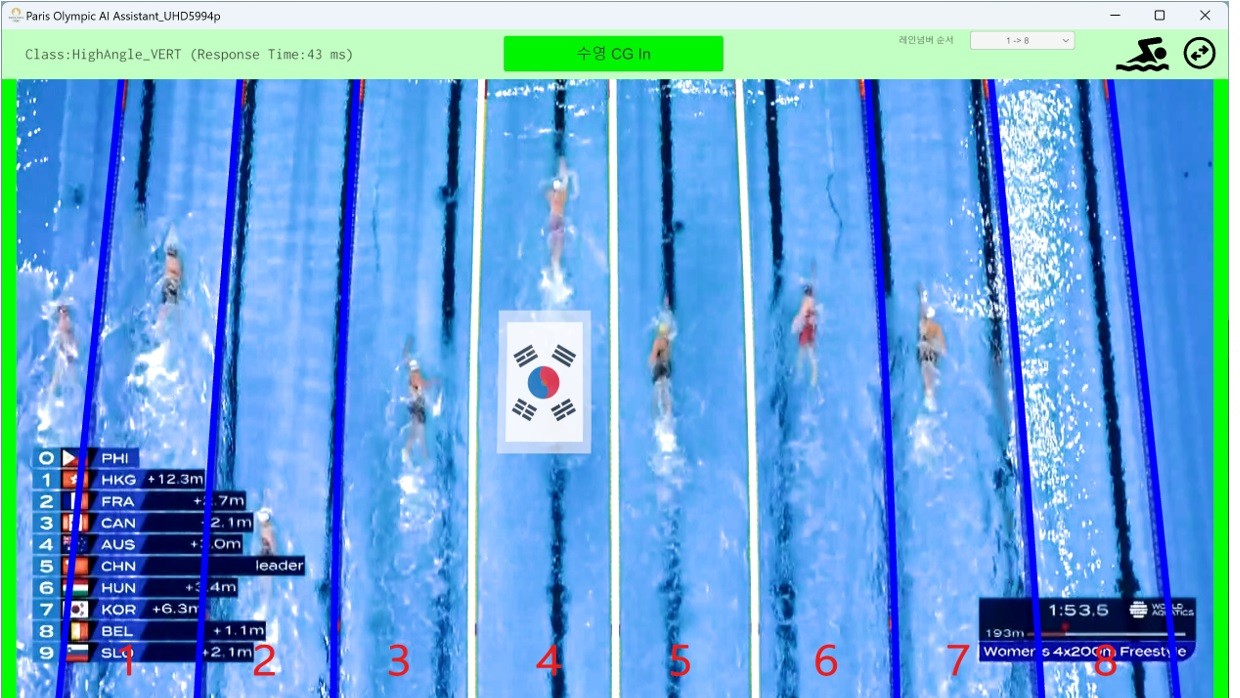
Tech Papers 2025: In this paper, we introduce an AI-powered broadcast assistant successfully deployed during the Paris 2024 Olympic swimming and fencing competitions
Abstract
Recent advances in computer vision and real-time graphics have enabled
significant improvements in augmented live sports broadcasts. However,
achieving the millisecond-level latency required for Olympic events remains
challenging. In this paper, we introduce an AI-powered broadcast assistant
successfully deployed during the Paris 2024 Olympic swimming and fencing
competitions. Leveraging a custom-built dataset comprising 520k annotated
frames, we developed two specialized deep-learning pipelines: (i) fine grained recognition and enhancement of signal lights in fencing, and (ii) high-angle scene understanding and lane recognition for swimming events. In fencing broadcasts, our assistant effectively magnifies small indicator lamps signalling valid touches. For swimming competitions, the system automatically detects overhead camera angles, segments individual lanes, and overlays national flags in real time. We present comprehensive overview of the system architecture, dataset creation methods, model architectures, and on-site deployment strategies. Live operational trials demonstrated significant improvements in broadcast efficiency, supported by an integrated human-in-the-loop approach to maintain editorial control. Finally, we investigate the applicability of our real-time scene classification and automatic CG cut-out methods to a broader range of sports, paving the way for more advanced AI-assisted broadcast systems.
Exclusive Content
This article is available with a Technical Paper Pass
Dynamic streaming content packaging with C2PA
Tech Papers 2026: This paper presents an implementation of the approach adopted by C2PA for live video to dynamic packaging.
.jpg)
Dynamic power control for sustainable broadcast transmitter networks
Tech Papers 2026: This paper proposes an approach that uses predictive modelling in combination with real-time interference monitoring to optimise transmitter powers dynamically, with minimal impact on the consumer.
.jpg)
A standardised framework for C2PA provenance in media workflows
Tech Papers 2026: This paper presents the first standardised framework for implementing C2PA for media provenance across newsrooms of varying sizes and operational contexts.
.jpg)
Building MXL together: Progress of the multi-vendor open-source media exchange SDK
Tech Papers 2026: This paper presents the Media eXchange Layer (MXL), an open-source SDK project hosted by the Linux Foundation in collaboration with the EBU and NABA.
.jpg)
Search first, inspect visually when needed: A multi-agent architecture for semantic video archival retrieval
Tech Papers 2026: This paper introduces Smart Chat, a multi-agent video question-answering system that searches indexed video moments, localizes candidate evidence, and inspects a short clip only when visual verification is needed.