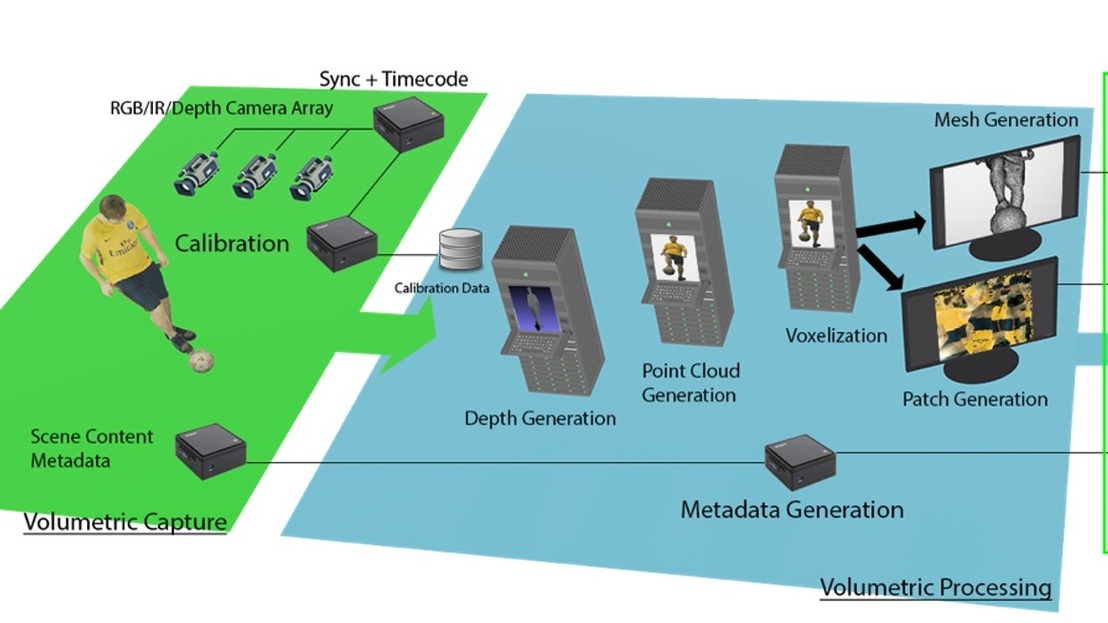
This paper offers a comprehensive overview of state-of-the-art volumetric video methods based on neural radiance fields, including their respective advantages and drawbacks.
Over the past decades, video consumption and video devices have become widespread globally. In 2014, mainstream virtual reality headsets marked a pivotal moment for 360° video accessibility. Advanced immersive devices, like the Apple Vision Pro as well as smartphones and tablets with advanced spatial capabilities can now provide users with real-time 6 Degrees of Freedom (6DoF) navigation experiences. However, the lack of engaging content is hindering potential applications in areas such as training and entertainment. Volumetric video is a promising solution. However, its production poses challenges, such as the need for natural 3D+t reconstruction, coding, and rendering, which still require intensive computational resources.
In 2020, the ground-breaking Neural Radiance Field (NeRF) paper introduced a new way to generate natural free-viewpoint renderings of real scenes from sparsely captured views. Follow-up research has led to faster and more flexible methods, such as the widely used 3D Gaussian Splatting. However, these approaches require independent models for each frame, posing a challenge for volumetric video representation. To address temporal limitations, extensions of radiance field techniques use temporal redundancy to create a compact, temporally consistent, and editable volumetric video representation.
This paper offers...
Exclusive Content
This article is available with a Technical Paper Pass
.jpg)
Dynamic power control for sustainable broadcast transmitter networks
Tech Papers 2026: This paper proposes an approach that uses predictive modelling in combination with real-time interference monitoring to optimise transmitter powers dynamically, with minimal impact on the consumer.
.jpg)
AI-driven anonymisation that preserves human performance
Tech Papers 2026: This paper presents two AI-driven workflows designed to preserve emotional nuance while ensuring anonymity.
.jpg)
Search first, inspect visually when needed: A multi-agent architecture for semantic video archival retrieval
Tech Papers 2026: This paper introduces Smart Chat, a multi-agent video question-answering system that searches indexed video moments, localizes candidate evidence, and inspects a short clip only when visual verification is needed.
.jpg)
A standardised framework for C2PA provenance in media workflows
Tech Papers 2026: This paper presents the first standardised framework for implementing C2PA for media provenance across newsrooms of varying sizes and operational contexts.
Dynamic streaming content packaging with C2PA
Tech Papers 2026: This paper presents an implementation of the approach adopted by C2PA for live video to dynamic packaging.
Registered users only: Login