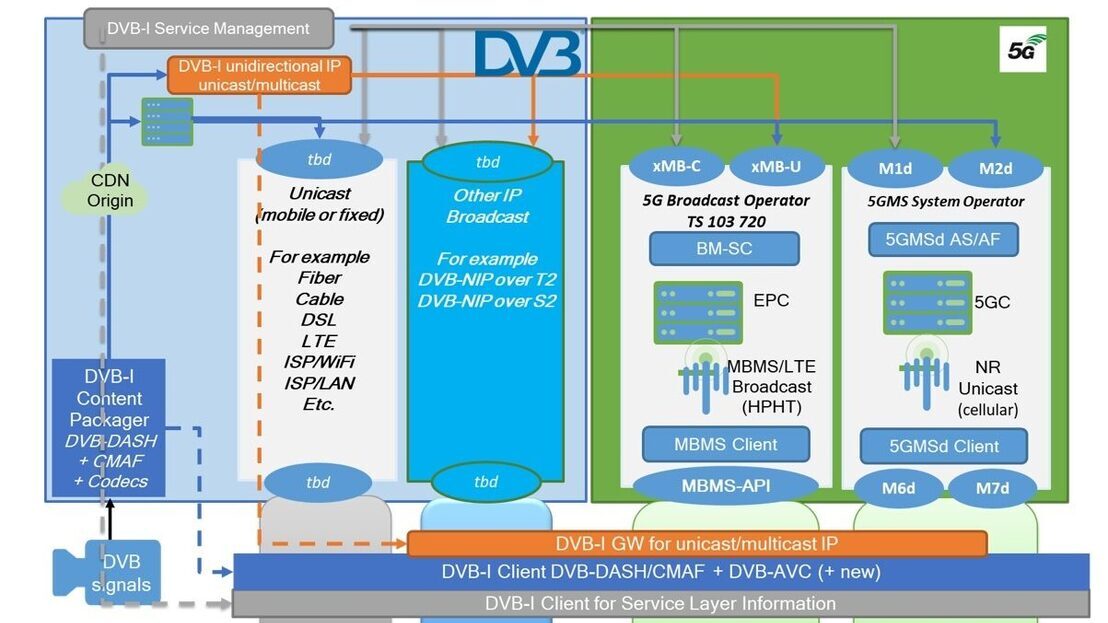
In this paper, we analyze how 5G Broadcast can be introduced and deployed while coexisting in the same UHF channel with several other legacy broadcast radio technologies, including ATSC 3.0, DVB-T2 and ISDB-T
5G Broadcast offers broadcast network operators the possibility of reaching mobile devices directly, without requiring additional hardware in smartphones. 5G Broadcast enables delivery of services such as linear TV, live content offload, or emergency messages to the general population while minimizing the hardware impact and the cost to the end customers.
When introducing a new broadcast standard, factors such as spectrum scarcity, the need to support legacy receivers, and regulatory constraints are of significant interest in non-greenfield markets. Due to these issues, in some cases it may not be desirable or feasible to vacate one entire broadcast UHF channel to deploy 5G Broadcast. Instead, a transition approach to refarming may be preferred, where the available bandwidth is flexibly allocated to 5G Broadcast or a legacy standard with a granularity finer than a broadcast UHF channel.
In this paper, we analyze how...
Exclusive Content
This article is available with a Technical Paper Pass
.jpg)
Dynamic power control for sustainable broadcast transmitter networks
Tech Papers 2026: This paper proposes an approach that uses predictive modelling in combination with real-time interference monitoring to optimise transmitter powers dynamically, with minimal impact on the consumer.
.jpg)
AI-driven anonymisation that preserves human performance
Tech Papers 2026: This paper presents two AI-driven workflows designed to preserve emotional nuance while ensuring anonymity.
.jpg)
Search first, inspect visually when needed: A multi-agent architecture for semantic video archival retrieval
Tech Papers 2026: This paper introduces Smart Chat, a multi-agent video question-answering system that searches indexed video moments, localizes candidate evidence, and inspects a short clip only when visual verification is needed.
.jpg)
A standardised framework for C2PA provenance in media workflows
Tech Papers 2026: This paper presents the first standardised framework for implementing C2PA for media provenance across newsrooms of varying sizes and operational contexts.
Dynamic streaming content packaging with C2PA
Tech Papers 2026: This paper presents an implementation of the approach adopted by C2PA for live video to dynamic packaging.
Registered users only: Login