
Online piracy costs US almost $30bn a year, according to Chamber of Commerce. Pirated videos viewed over 200bn times in 2018. Piracy results in up to 560,000 industry job losses.
Online piracy costs the US economy almost $30 billion a year, with pirated videos viewed over 200 billion times, according to a report from the US Chamber of Commerce.
The movie and television sector brought in around $230 billion in revenue in 2017, but streaming is a big problem. The report from Chamber of Commerce’s Global Innovation Policy Center found the cost of piracy could even be as high as $71 billion a year.
The GIPC’s report, which was released in partnership with NERA Economic Consulting, found that piracy carried out across streaming services have now surpassed download-based piracy as the primary vehicle for pirated videos. 80% of piracy is attributable to streaming compared with just a few years ago, when BitTorrent downloads accounted for nearly 40% alone.
Pirated TV shows have the highest demand, with more than 230 billion views every year worldwide, with the vast majority coming from outside the US. 126 billion of these views were of content produced in the US. Popular TV shows like Game of Thrones went to great lengths to reduce piracy ahead of its final season.
The film industry is also suffering due to piracy, with 26.6 billion illegal views of US-produced films, according to the study.
The impact of piracy on the industry is split across production and distribution. The former loses between $12.4 to $40 billion annually, while distribution sees losses between $900 million and $2.1 billion a year in the film sector. In the digital TV sector, the figures are between $14.7 billion to $35.7 billion for production and between £1.3 billion and $3.1 billion for distribution.
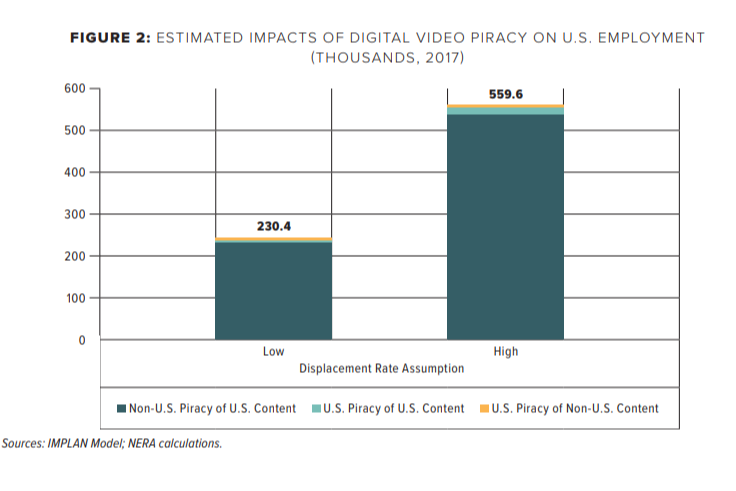
The impact of piracy isn’t limited to loss of revenue, however, with the GIPC’s report also assessing the impact on jobs. It found that digital video piracy resulted in between 230,000 and 560,000 job losses per year. In terms of GDP, piracy saw a reduction of US GDP between $47.5 billion and $115.3 billion in 2018.
David Hirschmann, president and CEO of the GIPC, said: “Digital video piracy results in significant losses to the U.S. economy, harming businesses ranging from content production firms to the innovative technology companies that are driving the digital distribution revolution.
“While there is no single solution, global collaboration among industries and governments to educate consumers of the dangers of piracy, coupled with the expansion of legal options in cases of infringement, is necessary to curb these negative effects. All parties must continue to work creatively and constructively to enable dreamers, innovators, and creators around the world to continue to tell their unique stories and advance our culture and economy.”
You are not signed in
Only registered users can comment on this article.
 (1).jpeg)
150 students take over On Air 2026’s five-channel broadcast
On Air 2026 will see 150 students take charge of the Media Talent Manifesto (MTM) broadcast’s 24-hour culture, news, sport, film, and kids channels on 22–23 October 2026.
 (1).jpg)
BBC Three and BBC Scotland linear channels to close
The BBC has confirmed the closure of BBC Three, BBC Scotland, and BBC Radio 4 Extra linear broadcast services in spring 2027.
.jpg)
EBU launches group to create shared live production tools
The European Broadcasting Union (EBU) has launched an open live production cloud group for its public service broadcasting members to build shared live production capabilities.

Noel McClean appointed Head, Bectu
Bectu has appointed Noel McClean to head the union for broadcasting, live events, and theatres.
 (1).jpg)
BBC licence fee could extend to streaming services
The BBC licence fee could be extended to online streaming services such as YouTube, Netflix, Amazon, and Disney+, according to reports.

 (1).jpg)
.jpg)
.jpg)