
Tech market analysts Omdia reveal their latest findings that show a significant shift in the connected TV (CTV) market with hardware manufacturers increasingly capitalising on platform revenues rather than hardware sales. Companies such as Roku and Vizio are even accepting losses on hardware to focus on more lucrative revenue streams from their platforms.
Roku is at the forefront of the CTV advertising space, with projections indicating it will generate $5 billion in revenue by 2029. This forecast includes income from Free Ad-Supported Streaming TV (FAST), CTV user interface ads, and third-party inventory shares.
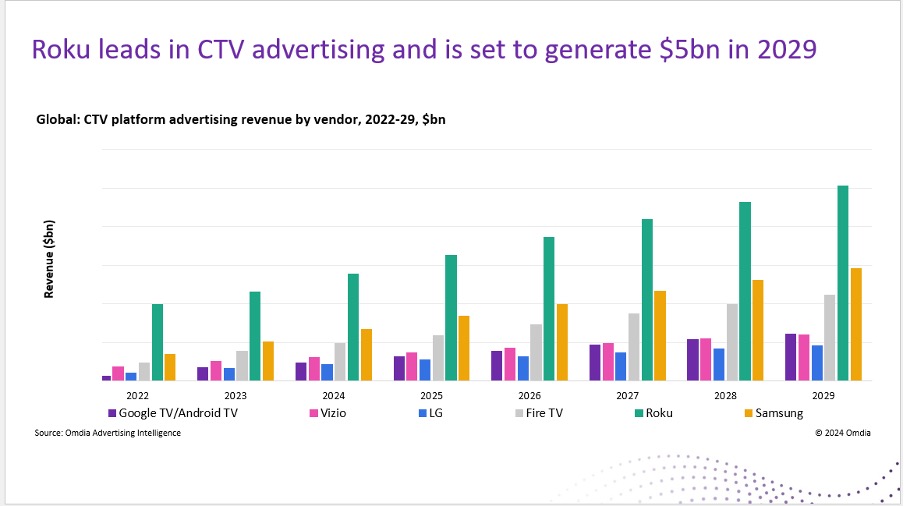
Roku’s dominance in CTV advertising is expected to drive the industry, which is forecasted to double by 2029 compared to 2024 levels. Currently, Roku is the leading CTV player in the US, the world’s largest advertising market, with 20% of US TV sets powered by its platform, enhancing its advertising success and setting a benchmark for competitors.
Samsung, the second-largest player in the CTV market, is also anticipated to see substantial growth, with revenues projected to reach $3 billion by 2029 - more than doubling from $1.35 billion in 2024. Samsung’s extensive global presence enables it to maintain strong competition with Roku, despite Roku’s dominance in the largest advertising market.
Walmart’s acquisition of Vizio highlights its strategic move to tap into the expanding CTV revenue streams, with plans to explore new avenues such as retail media and shoppable TV in the U.S., indicating shifts in the competitive landscape.
The total CTV advertising market is set to grow from $6.65 billion in 2024 to $13.5 billion by 2029, with Roku expected to lead this expansion, projecting revenues of $2.8 billion in 2024 and rising to $5.1 billion by 2029.
“Roku’s success is driven by its position as the largest platform in the top advertising market, while Samsung maintains strong competition through its broad international reach,” said Maria Rua Aguete, Senior Research Director, in Omdia’s Media and Entertainment practice. “As the CTV advertising market is set to double, both Roku and Samsung are strategically positioned to leverage this explosive growth.”
Watch Maria Rua Aguete’s sessions at IBC2024 in Amsterdam which delve into the key drivers of growth in the media and entertainment market, the rise of streaming video, evolving advertising business models, and the impact of AI on the industry.
You are not signed in
Only registered users can comment on this article.
.webp)
France Télévisions and TDF test 5G broadcast of Diagonale des Fous
For the mountain ultramarathon Diagonale des Fous, TDF has rolled out a 5G broadcast trial in partnership with France Télévisions, Antenne Réunion, and Web TV Grand Raid.
 (1).jpg)
CNN and Financial Times sign AI deal with Google
CNN has signed a strategic multi-year partnership with Google, which will see the organisation provide enhanced content rights for Google’s generative AI news product pilots.
 (1).jpeg)
150 students take over On Air 2026’s five-channel broadcast
On Air 2026 will see 150 students take charge of the Media Talent Manifesto (MTM) broadcast’s 24-hour culture, news, sport, film, and kids channels on 22–23 October 2026.
.jpg)
IBC calls for Challenge submissions for 2027 Accelerators
IBC has launched the official call for Challenge submissions for its 2027 Accelerator Media Innovation Programme.
 (1).jpg)
BBC Three and BBC Scotland linear channels to close
The BBC has confirmed the closure of BBC Three, BBC Scotland, and BBC Radio 4 Extra linear broadcast services in spring 2027.
.jpg)


.jpg)