According to a panel of leading media education experts on the IBC2026 Future Tech Ignite stage, one of the key issues facing M&E is the development of realistic expectations between further education and industry.
The latest numbers from the IAMT survey showed the industry doesn’t believe graduates are industry-ready, something Polly Hickling, VP Education, SMPTE, disagreed with as she chaired the “Further Education for the Industry? Closing the Gap Between Media and Academia” panel.
A student at Southampton Solent University, Jonathan Bendor-Samuel, described the various ways his course has prepared him for his transition to industry, including a well-equipped live event society and extracurricular work experience. He also highlighted the importance of networking, understanding workflows, and the industry he is entering. When explaining what potential students are looking for in a course, he asked: “What is the image that the course is painting, versus the reality of what is actually out there, what will I be using my skills for, and how will I be applying my in-classroom learning?”
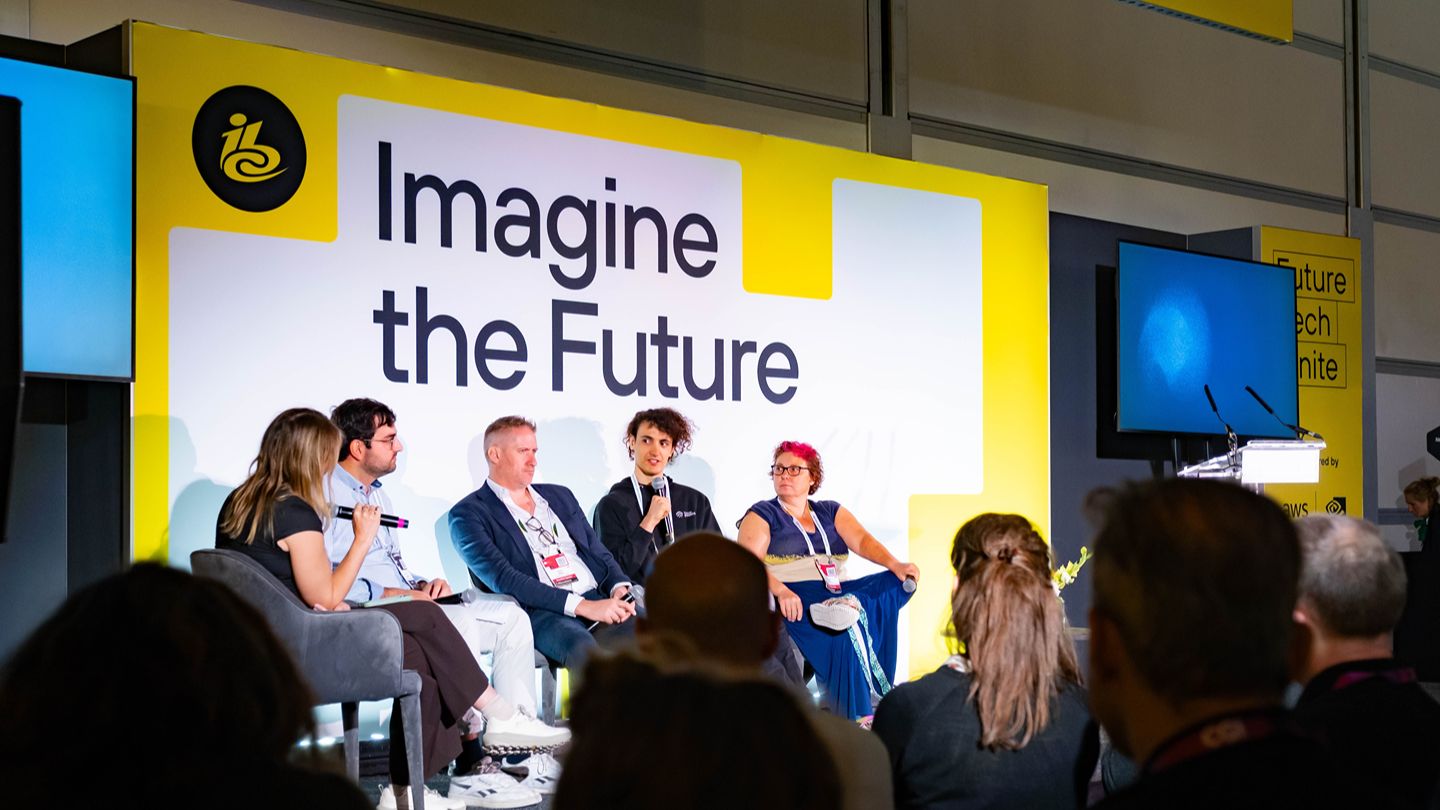
“In a collaboration between a student group and a company, what are both parties expecting?”, added Shant Bayramian, Lecturer, Researcher, Director, Emerging Tech, lnholland University of Applied Sciences. “The university’s utmost priority is keeping its values intact and developing students. How do you keep that in line with what companies are looking for? Sometimes both values are not completely aligned. I think we need to co-create a value system and then operationalise that.”
lnholland University of Applied Sciences runs a lab programme that brings together students from different creative and cultural fields to apply emerging technology knowledge to their own field. According to Bayramian, it’s more important to facilitate a knowledge-sharing environment than to inundate students with knowledge.
“How do you create a formal educational system with credits and assessments that applies to that?”, he pondered. “The lab is trying to give the physical, unstructured space to enable the industry, students, and even civil society to work together on specific problems. Our job as lecturers is to coach and facilitate that.”
When it came to the impact of AI on this process, the session highlighted that agentic workflows are part of the world of graduating students at the Amsterdam University of Applied Sciences. “This isn’t because it’s part of their curriculum, but because they work in industry and can see the problems it solves,” said Barbara Devilee, Senior Lecturer, Researcher, Amsterdam University of Applied Sciences, who noted that the creation of content is going the same way. “We don’t need content makers anymore, but conductors. The AI can make the content in different ways, and you have to orchestrate it.”

IBC2026 Live Blog: Catch up with all the best innovations
Welcome to the IBC2026 Live Blog, getting under the skin of the global media and entertainment industry's biggest and best trade show.
.jpg)
FAST is the next frontier of creator domination
The creator economy is no longer a sideshow in Free Ad-Supported Streaming TV (FAST) but a core channel segment with platforms actively competing for content.
Global student On Air project is already igniting careers
On Air, the global student‑run broadcast initiative, is scaling up in its second year.
.jpg)
The pull era: Why media survival hinges on the phone-centric consumer
To survive, this industry must redefine broadcast, move beyond defunct binaries like "TV viewer" and "mobile user", and put its consumer at the centre of every decision, according to Evan Shapiro's rapid-fire talent programme keynote on the Future Tech Ignite stage.
.jpg)
LA28 set to rewrite the broadcast rulebook
The Los Angeles 2028 Olympic Games are set to become the largest broadcast operation ever attempted.
 (1).jpg)