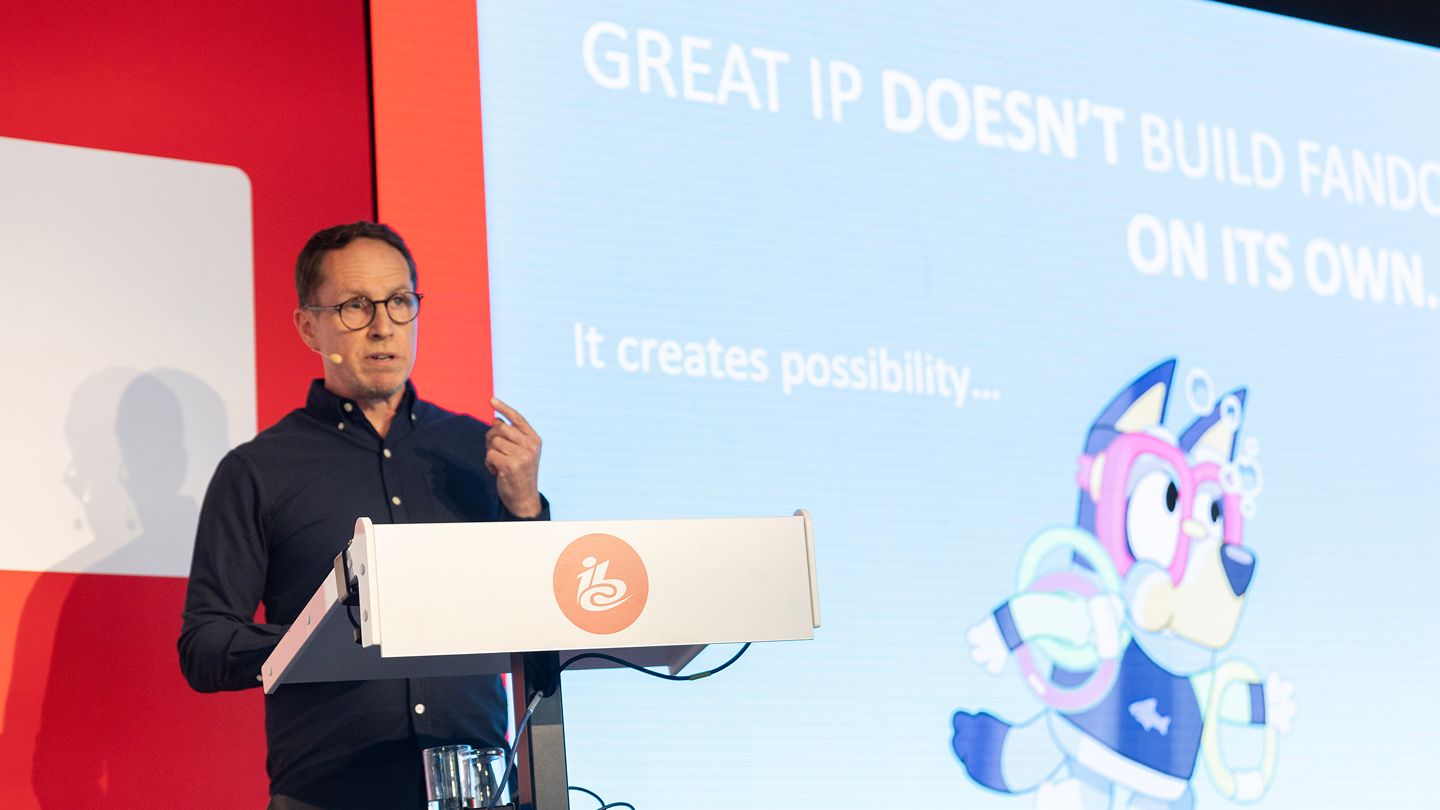
A penultimate presentation on Day 2 in CR1 saw Simon Clarke, Director, Digital, Bluey, BBC Studios Digital Brands, present: “Fandom First: How are alliances expanding reach and retention?". Addressing the IBC2026 audience, Clarke unveiled some surprising stats, as well as a fascinating look under the hood of the much-loved children’s character.
“Bluey is truly exceptional. The storytelling is warm. It's funny. It's relatable, and I think from the moment that people meet Bluey, there's a real engagement from that whole audience”, he opened by noting. “But scale conceals strategy. Affection is not the same as fandom, and popularity is not the same as having a strategy. Great IP doesn't decide which platforms to enter, doesn't recognise an emerging adult audience, and also doesn't brief a creator. Put simply, great IP doesn't automatically create fandom.”
Bluey had 1.5bn hours of watch time in 2025, in spite of no new episodes being created that year. This is no accident, according to Clarke: “The first thing that we do for Bluey is we follow the audience. The starting label for Bluey was always preschool, but we quickly realised through those data signals that the audience behavior told a much richer story. Children were watching, but parents were also watching, and they weren't just supervising – they were participating.”
%20SR.jpg)
YouTube has been a crucial component of this multi-channel, mutli-touchpoint strategy, Clarke emphasised. “For Bluey, this means having a full channel strategy with different entry points for different interests. It's really important for us to take a step back and to look at the power of YouTube. Connected TV viewing is soaring. We know that, but connected TVs are now a number one viewing device across all of our YouTube channels. YouTube really is driving that discovery, and it's really key to finding a new brand or a new product. This is why YouTube is the keystone of our ecosystem. We have one show, Bluey. We have 27 YouTube channels, and we'll be launching more soon. We have our main Bluey YouTube channel, but we've localised that into 19 different languages.”
According to Clarke, 77% of US parents co-view YouTube with their children. “We saw older children growing with the brand, and we saw adults quoting, creating content, and sharing content. We saw emerging audiences on TikTok and jumped on that straightaway.”
With this diversity of channels, there is constant value to be derived from monitoring the audience response – data is crucial, maintains Clarke. “It really is true that the comment section is not the end of the publishing process. It's the beginning of the next brief. Everything we create is rooted in data and fan responses. We listen to comments, check for repeat behaviors, and monitor community signals. Community management is a hugely important part of our process. It's something we invested hugely in from day one, and it's paid dividends for us.”
One partnership highlighted by Clarke was with Lego – Bluey Lego shorts have received 53m global views, totalling 1m hours of watch time. “Watch time matters because it tells us people choose to stay. Return behavior tells us we're building habits, and comments and creations show we've got participation, and sharing recommendations show advocacy. While reach tells you someone noticed, it is fandom that tells you that someone cared. Great content builds attention, and culture builds that affinity. That relationship can then support sustainable commercial growth, but the order must never be reversed.”
“Great IP, such as Bluey, gives you a remarkable beginning, but lasting fandom really is built on what comes next. The future won't belong simply to the broadcaster with the biggest audiences; it will belong to those who are willing to build relationships with the fans and the audiences directly”, he summarised.

IBC2026 Live Blog: Catch up with all the best innovations
Welcome to the IBC2026 Live Blog, getting under the skin of the global media and entertainment industry's biggest and best trade show.
.jpg)
FAST is the next frontier of creator domination
The creator economy is no longer a sideshow in Free Ad-Supported Streaming TV (FAST) but a core channel segment with platforms actively competing for content.
Global student On Air project is already igniting careers
On Air, the global student‑run broadcast initiative, is scaling up in its second year.
.jpg)
The pull era: Why media survival hinges on the phone-centric consumer
To survive, this industry must redefine broadcast, move beyond defunct binaries like "TV viewer" and "mobile user", and put its consumer at the centre of every decision, according to Evan Shapiro's rapid-fire talent programme keynote on the Future Tech Ignite stage.
.jpg)
LA28 set to rewrite the broadcast rulebook
The Los Angeles 2028 Olympic Games are set to become the largest broadcast operation ever attempted.
.jpg)
 (1).jpg)