
At IBC's Smart Stories Accelerator Incubator, Joe Croney, Founder, CEO, HyperContent.AI, explains how a new open standard, the Story Object Model (SOM), is giving some of the world’s most prestigious newsrooms AI's speed without sacrificing editorial control.
Newsrooms including AP, the BBC, Al Jazeera, Reuters, and the Washington Post are backing the “Smart Stories - The New Knowledge Architecture for Content Production” incubator project in hopes of getting newsroom AI tools to work together instead of in silos.
Croney spent years as CTO of Arc XP, the Washington Post's newsroom technology division, before founding HyperContent.AI, one of the vendors building on the project's new open standard, SOM. It's a shared "bus" that lets transcription tools, clipping agents and publishing systems talk to each other directly, cutting out the manual handoffs that eat up a producer's day. Nevertheless, Croney highlighted that journalist approval is key and that the input of the news and footage stays in the hands of journalists.
To put it to the test, IBC Reporter Esmee van Loo fed her own scoop through one of the AI agents in the story object model. Earlier that day, van Loo had reported a story about 1,000 coins hidden around the IBC halls by a VLC volunteer named Julien Navas. Croney ran the footage through the SOM bus and the HyperContent.ai tool, and it delivered vertical reels, a newsletter, and a news article with video. The AI understood the main message of the footage even though she had tried to dilute it by adding another storyline in the middle of the video. Something about balloons and North Korea, as the VLC volunteers have sent balloons across the border with USB drives containing modern-day TV shows such as Game of Thrones.
Verizon: 5G learnings from the summer of FIFA
Fresh from building a "battle-tested" network for FIFA, Robb Juliano, Vice President, 5G Acceleration, Verizon Business Group, explores how 5G and private wireless networks are creating efficiencies and resilience for broadcasters across the media pipeline.
0% of students "ready for job" – IAMT report
Experts react to a new survey from the IAMT which found 0% of industry leaders think current education programmes effectively prepare candidates for technical M&E roles.

How to deliver live low-latency video at scale
Across the streaming ecosystem, demand for seamless, premium-quality live video delivery has never been higher. For live streaming platforms like nanocosmos, finding ways to guarantee low-latency video delivery at scale is paramount to ensuring high-quality end user experiences. Lukas Navickas chats to Oliver Lietz, CEO of nanocosmos about:- Real-time live streaming and its use cases- How Nanocosmos differentiate themselves in the world of live video delivery- The key challenges that come with growing a streaming platform - The role of infrastructure in facilitating live video delivery at scale.

From Pixels to Personas: The Role of Digital Humans in Modern Media
Hyper-personalization has become the new hot-button in media and entertainment, and now it takes on a new face through natural digital human avatars. This talk explores the latest advancements in digital human technology and their implications for film studios and broadcasters. Attendees will gain insights into the innovative tools and techniques driving the creation of hyper-realistic digital characters, and how these advancements enhance narrative depth and audience immersion. They will also learn how NVIDIA ACE and related technologies enable digital human development with AI models for speech and translation, vision, intelligence, lifelike animation and behavior, and realistic appearance. Whether you are a developer, artist, or enthusiast, this session will provide valuable insights into creating digital humans that can see, hear, understand, and interact with the world around them.
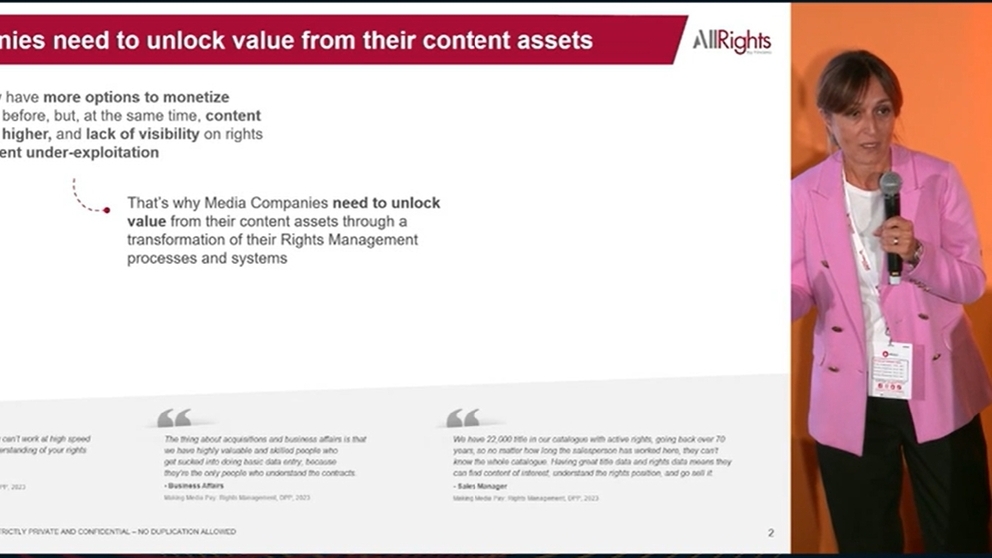
AllRights: The outstanding rights management solution by Fincons to speed up processes, reduce manual errors and optimise content exploitation & monetisation
IBC2023: Given the competitive market environment, media companies have begun a review of their rights management needs to ensure a unique and centralised enterprise-view of content rights that matches their fluid approach to content. To do this, they are finding the need to use tools for a whole range of processes to make their content work harder for them, turning it into intelligent content.
.jpg)
.jpg)