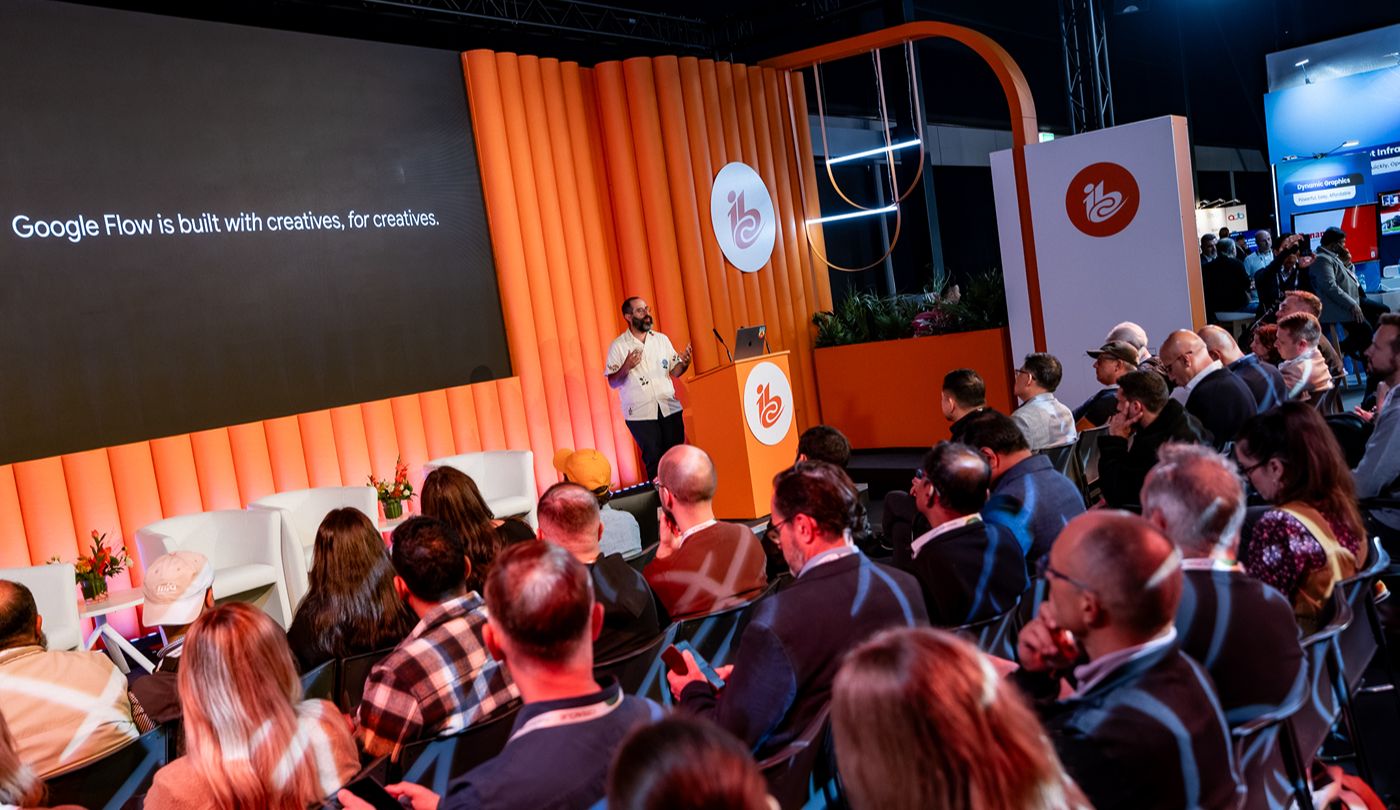
With a packed audience, full of senior Google and DAZN employees, the scene was set for a big reveal on the Delta Protocol Accelerator project's ability to shift video transmission from frame-by-frame delivery to scene understanding and semantic intelligence.
Led by Sandeep Tiku, CTO, DAZN, who flew to IBC2026 from the US specifically for the presentation, the Saturday pre-lunch slot on Hall 14’s Future Tech stage was at capacity for the IBC Accelerator project, "Delta Protocol: The Future of Live Streaming".
“We promised that we would bring proof to the industry in September. This is here. Second, in two years we'll bring it to a final design point, and in three or five years, we will make it available for the industry”, he said.
.jpg)
Tiku led the charge with the wider context of the Accelerator, a three-phase approach with the IBC Accelerator as the industry proof, followed by implementation throughout DAZN, then a final phase of consultation and adoption aimed at establishing an industry standard.
“We promised that we would bring proof to the industry in September. This is here. Second, in two years we'll bring it to a final design point, and in three or five years, we will make it available for the industry”, he said.
Freely admitting that the Delta Protocol is something of a passion project, he laid out the state of the industry today. He said: “We have spent years reducing latency and delivering improved consumer experience, but fundamentally we have optimised the same thing again and again. The problem is we have to manage the resulting complexity that is probably not genuinely required. That leaves no time for innovation. The cost is also increasing every day, while piracy is also strangling the industry, and latency has still not been fully solved. While we talk about personalisation today, it is fake personalisation – not part of the stream. Likewise, while we speak of the need for hyperpersonalisation, that is simply not possible today.”
This is where Tiku believes that Delta Protocol will transform the streaming industry. He continued: “We can solve this by transmitting what matters, not every pixel. We will transmit intelligence, not the same pixels millions of times. Delta Protocol is the answer.”
Delta Protocol, he explained, is defined as a scene-native live media architecture that: converts a live event into a verified, time-synchronised authoritative event state; transmits only meaningful deltas of that state; and reconstructs a personalised live experience at the destination.
“We will transmit live events at maybe 60-90% less in the future. When we ran this test, some of them were actually as good as 97% less. As a result, the cost of end-to-end production can be reduced by at least 60-70%,” claimed Tiku.
“More importantly, now there is no pixel pipe. The pixel pipe has stopped, so how is the pirate going to capture it from the pipe? Because there's no pipe anymore. So it will make it extremely difficult for pirates to steal”, he enthused.
Chris Hampartsoumian, Customer Engineer, Google Cloud, Media, Entertainment, Google, demonstrated Gemini Omni Flash as part of the presentation, playing a synthesised Pele "perfect goal" clip that was never filmed in reality, only described by stadium viewers and press photographers, commenting: “The pace of innovation is unstoppable!”

IBC2026 Live Blog: Catch up with all the best innovations
Welcome to the IBC2026 Live Blog, getting under the skin of the global media and entertainment industry's biggest and best trade show.
.jpg)
FAST is the next frontier of creator domination
The creator economy is no longer a sideshow in Free Ad-Supported Streaming TV (FAST) but a core channel segment with platforms actively competing for content.
Global student On Air project is already igniting careers
On Air, the global student‑run broadcast initiative, is scaling up in its second year.
.jpg)
The pull era: Why media survival hinges on the phone-centric consumer
To survive, this industry must redefine broadcast, move beyond defunct binaries like "TV viewer" and "mobile user", and put its consumer at the centre of every decision, according to Evan Shapiro's rapid-fire talent programme keynote on the Future Tech Ignite stage.
.jpg)
LA28 set to rewrite the broadcast rulebook
The Los Angeles 2028 Olympic Games are set to become the largest broadcast operation ever attempted.
.jpg)
 (1).jpg)