
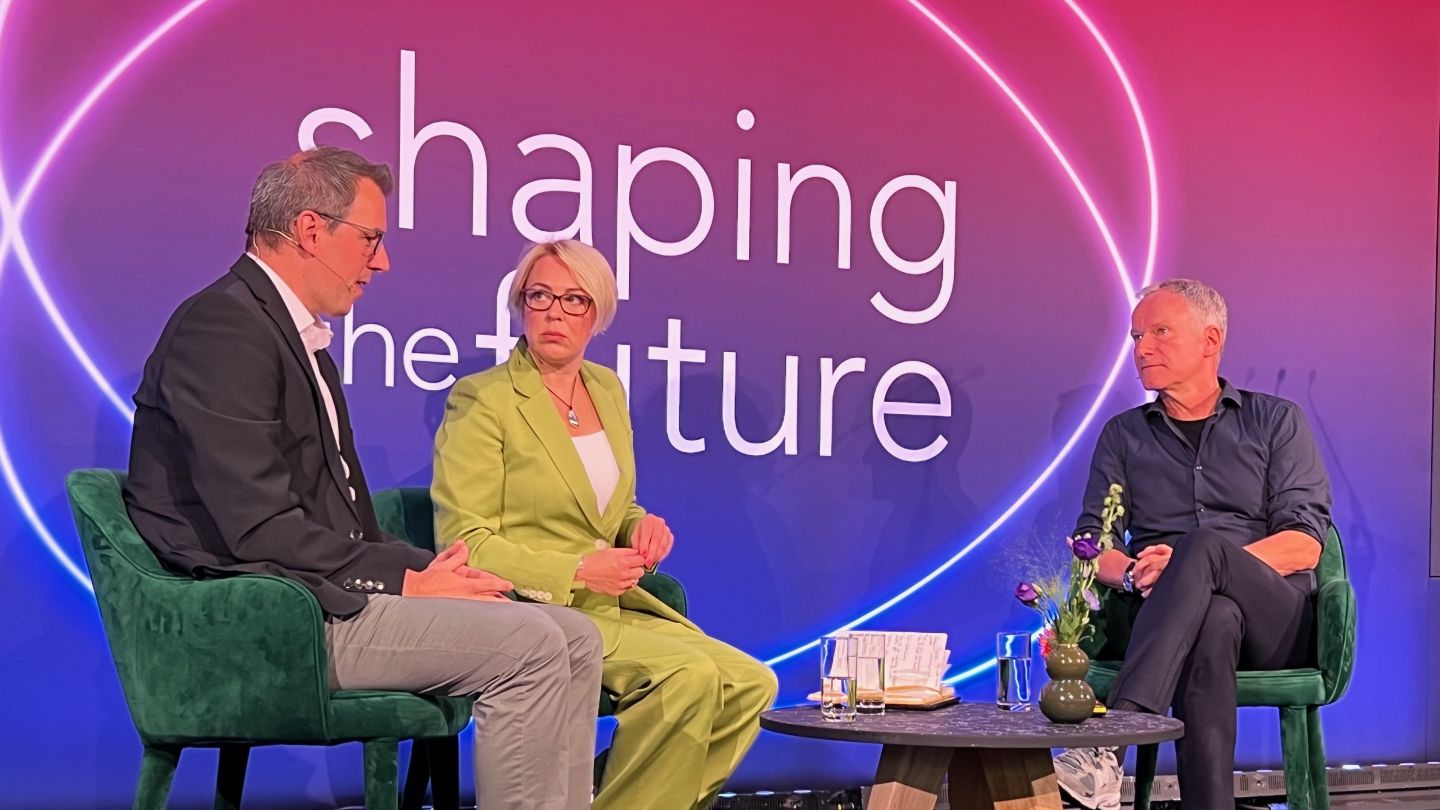
IBC Conference: ProSiebenSat 1 PULS 4’s Thomas Gruber and Fremantle’s Jens Richter explored how broadcasters can survive and thrive in an AI-driven, social media-saturated landscape.
Overall, Thomas Gruber, Co-CEO of ProSiebenSat 1 PULS 4, emphasised the role of local culture as a safeguard for authenticity, while Jens Richter, CEO Commercial and International at Fremantle, pointed to the need for global scale, and both warned that fake and manipulated videos threaten trust across the industry.
Austria Television’s hyperlocal blueprint
Gruber opened with a stark challenge: “By 2030, up to 90% of content could be created by AI. So, here’s the big question for broadcasters: how do we stay relevant? How do we grow? The answer isn’t more polish, it’s more human.”
For Gruber, Austria’s unique market requires authenticity above all. “Austria’s media market is shaped by linguistic overlap, delayed liberalisation, and cross-border competition,” he said. “It’s a market that demands strategic thinking, local insights, and a deep understanding of its unique structure.”
That philosophy is embodied in addressable TV (ATV). “ATV wins with real local stories. It connects with viewers through formats that are raw, authentic, and emotional.” He added, “ATV proves that deep cultural understanding, a commitment to raw authenticity, and the courage to be unremorsefully yourself are the keys to building the last media powers.”
The opportunity and risk of AI
While Gruber sees potential in AI to increase efficiency and creativity, he stressed the risks of losing authenticity, “AI [creates] too much content and [has] the risk of losing authenticity, but it also opens up new opportunities,” he said. “Human content will serve as the master template for AI – authenticity, emotional depth, and cultural nuance are qualities AI cannot replicate.”
Both he and Richter raised alarms about manipulated media. For Gruber, the danger is existential. “Without regulation for fake news – we’re losing it,” he said. “I have two daughters, and it’s horrible. I try to get them away, because they have to understand. You can’t just leave them in the digital world.”
Fremantle’s global approach
Jens Richter echoed Gruber’s focus on localisation but brought in Fremantle’s international perspective. “We produce in 28 countries around the world. Last year, we produced more than 12,000 hours of programming. We sold more than 30,000 hours of programming to broadcasters and platforms.”
Community connection, he said, drives success: “Really local culture, the local audiences, connecting with the local habits and cultures – that’s key for us.”
He also drew attention to the ways that social media and attention spans are reshaping production. “When you launch a drama now, something needs to happen in the first scene – there needs to be this hook.” He also emphasised that broadcasters need to be realistic about how people today are watching television. “Our audiences consume a lot of social media,” he said. “You have to assume they are on their second screen.”
Combating fakes, building trust
Richter underscored how fake and manipulated videos are already damaging established brands. “We did have an issue with YouTube. We found millions and millions of views generated with fake videos where people manipulated Got Talent,” he said. “Some stuff was really not on brand.”
He welcomed YouTube’s move to demonetise such content: “It was a huge, important step, because when we looked into this situation, it wasn’t kids in their bedrooms doing this. Those were professional producers who did it at scale.”
For both leaders, trust and brand safety are now competitive advantages. Gruber said: “Advertisers want to be in a safe area for linear television and streaming… but on social media, you cannot guarantee brand safety.”
Richter added: “Our job is quality and trust… that will also be the stuff that helps the brands in their communication.”
Local roots, global perspective
Despite their different vantage points, both Gruber and Richter agreed that combining authenticity with agility will define the next generation of winners.
“If we do not reflect our own culture, we cannot connect,” Gruber concluded.
Richter added, “The distribution landscape is not going to stabilise. The companies that succeed are those that can move with it quickly.”
Italy’s MediaForEurope (MFE) recently made moves to become the majority shareholder of Germany’s ProSiebenSat.1. Discover more here.
.jpg)
Call my agent: Agentic AI begins buying media advertising
AI agents have the potential to automate media transactions at scale, but today’s focus is less about fully autonomous workflows and more on experimentation and efficiencies.
.jpg)
NAB Show New York: The stakes could not be higher
As media, technology, and politics become increasingly intertwined, the stakes extend far beyond the balance sheet.
.jpg)
6G-Holonet: Bringing Star Trek’s comms system to reality
As the 6G-Holonet project sets its sights on live entertainment, cultural heritage sites, and immersive media, Alex Buchan, Chief Technology Officer, DTG, reveals the key technological considerations that have ensured the project’s impact.
.jpg)
ULL-timate goal: How streamers are prioritising ultra-low latency
With audiences expecting instant global information, and broadcasters competing against social platforms that deliver clips within seconds, the race is on to deliver ultra-low latency (ULL) as a competitive edge.
RTS Convention: “The prize for standing still simply isn't an option”
AI was largely sidelined at the annual RTS gathering where the fate of public service media took precedence. Adrian Pennington reports.
.jpg)