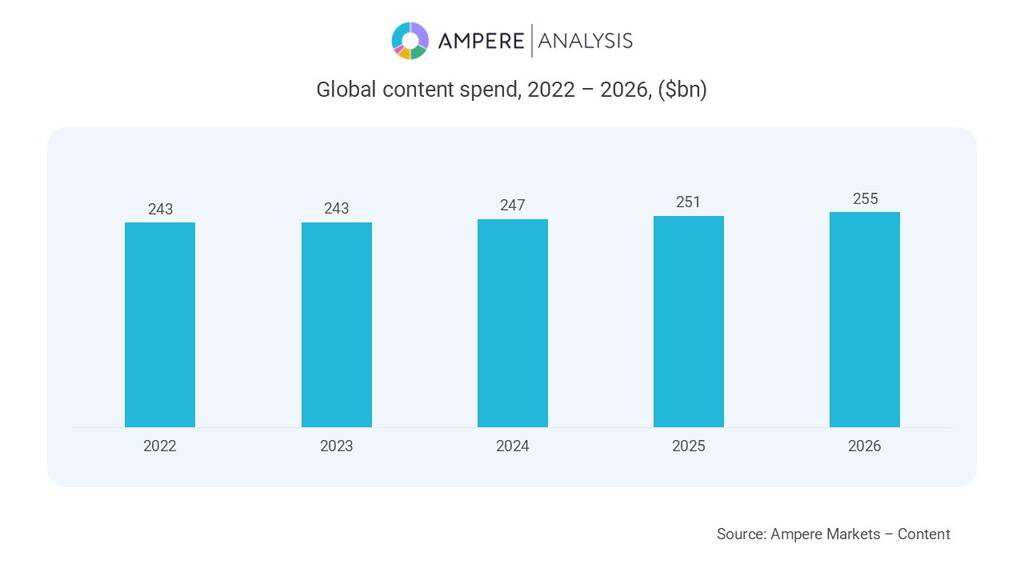
Global content investment will reach $255bn in 2026, rising a modest 2% year-on-year, according to new forecasts from Ampere Analysis.
The research found that global streaming platforms will remain the primary driver of growth in content investment. Ampere Analysis has forecasted that ad-funded and subscription-based streamers will spend $101bn on content in 2026, representing around two-fifths of total global content spending.
Traditional broadcast models face a more constrained outlook. Ampere expects pay TV, commercial broadcasters, and public broadcasters to see stagnant or declining content investment, reflecting ongoing pressure on advertising revenues and rising production costs.
As a result, the divergence between global streamers and local broadcasters will reportedly continue to widen. While international streaming services scale investment, local broadcasters face increasing challenges sustaining content output amid rising costs, ongoing advertising pressure, and shifting post-pandemic viewer behaviour.
In the US, commercial broadcasters are reducing spend as studio parent groups redirect budgets to their owned streaming platforms. In contrast, broadcasters outside the US show slightly better resilience, maintaining their investment levels through 2026.
Major global sporting events, including the football World Cup and Winter Olympics, will provide a boost to content spending in 2026. Historically dominated by broadcast television, streaming platforms continue to expand their sports strategies, with platforms such as Amazon Prime Video securing major National Basketball Association (NBA) rights through 2026.
Peter Ingram, Research Manager at Ampere Analysis, said: “Spend in 2025 was in line with Ampere’s expectations, marked by streamers overtaking commercial broadcasters for overall contribution to the content spend landscape for the first time. In 2026, we expect streamers to further build on this, seeing 6% growth in expenditure. The accelerating shift in content investment toward streaming underscores a structural rebalancing of the global TV market, with scale and reach emerging as the central competitive differentiators for operators to remain buoyant.”
Guy Bisson, Executive Director and Co-Founder at Ampere Analysis, recently joined IBC365 and four top media analysts to reveal his data-backed assessments of 2025, as well as his predictions for 2026 and beyond. Discover more here.
 (1).jpeg)
150 students take over On Air 2026’s five-channel broadcast
On Air 2026 will see 150 students take charge of the Media Talent Manifesto (MTM) broadcast’s 24-hour culture, news, sport, film, and kids channels on 22–23 October 2026.
 (1).jpg)
BBC Three and BBC Scotland linear channels to close
The BBC has confirmed the closure of BBC Three, BBC Scotland, and BBC Radio 4 Extra linear broadcast services in spring 2027.
.jpg)
EBU launches group to create shared live production tools
The European Broadcasting Union (EBU) has launched an open live production cloud group for its public service broadcasting members to build shared live production capabilities.

Noel McClean appointed Head, Bectu
Bectu has appointed Noel McClean to head the union for broadcasting, live events, and theatres.
 (1).jpg)
BBC licence fee could extend to streaming services
The BBC licence fee could be extended to online streaming services such as YouTube, Netflix, Amazon, and Disney+, according to reports.