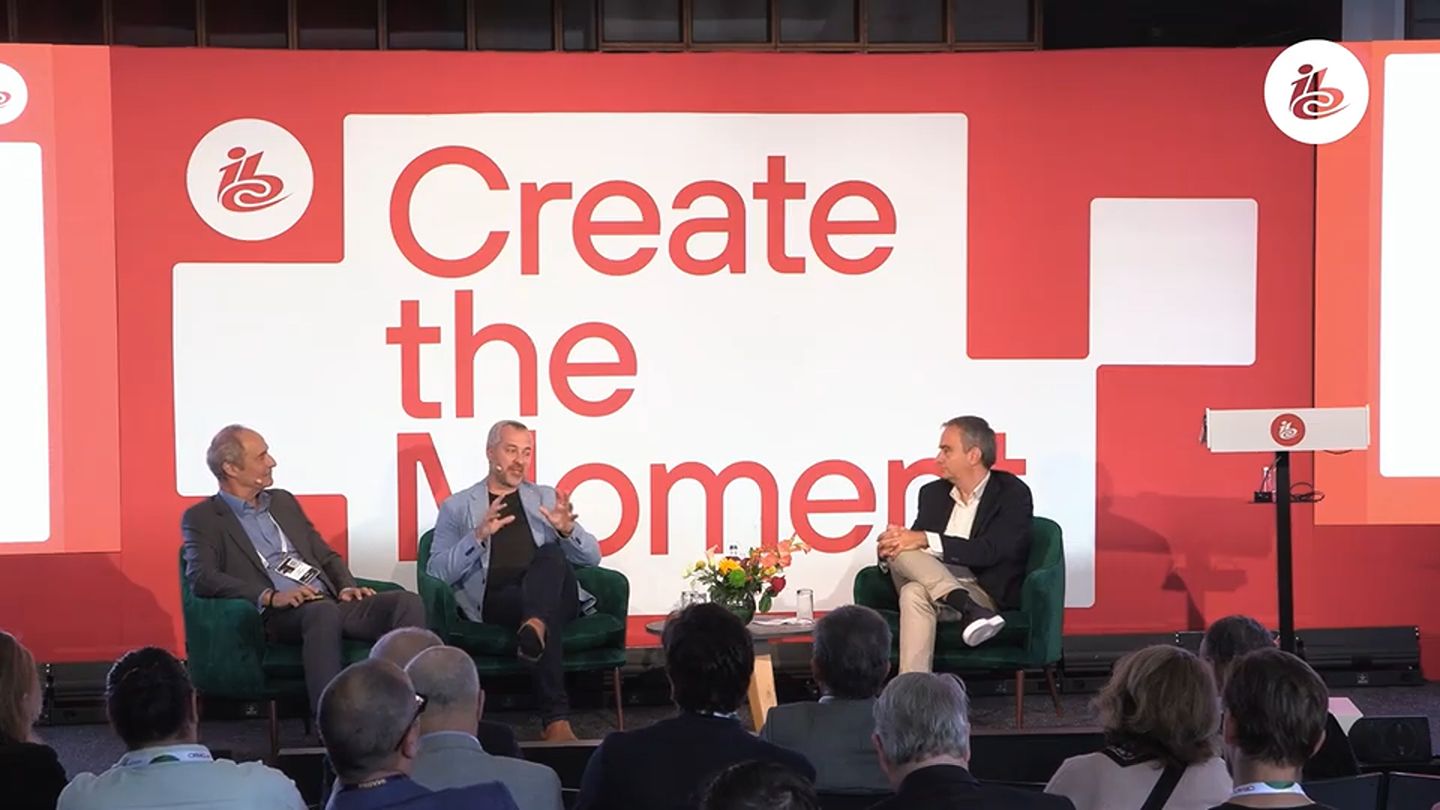
At IBC2026, Adam Jones, Director, Production Technology, Innovation, Innovative Dreams, dug into the details of integrating generative AI and virtual production into his filmmaking pipeline with Sean Wallitsch, Senior Visual Compute Solutions Architect, Amazon Web Services.
Kicking off Saturday morning on the Future Tech Stage, a fireside chat titled "Hybrid Filmmaking: How Innovative Dreams Is Rewriting the Rules of Production", Jones took an ameliorative stance on industry backlash to AI use, outlining the benefits he has found so far, as well as pointing to the need for education around the technology’s use.
“It's a delicate situation; patience is really key. [When people are negative about GenAI use] I realise that that person is probably one of two things: they're either opposed to it because they're threatened by it, or they're opposed to it because they don't know anything about it, so either way, what I need to do is I need to be a patient educator.
“I have a director that I've spent multiple hours on the phone with. We sit together to go through the results, and I show him an overlay to demonstrate that the performance is retained. You have to be incredibly patient and loving with people, and realise that they just need education. I eat and breathe this all day. You have to give them a moment to acclimatise”, he summarised.
.jpg)
Jones was unsurprisingly assertive about the potential of GenAI combined with virtual production, telling an anecdote about shooting season two of hit series House of David.
“We were filming on location in Greece; it's very dry, and there's a lot of fires, and so you have to be very mindful when you introduce any fire element. We have a particular scene in season two where it's a forest fire. So we created the background from photos that I had taken to make this forest. Then we [virtually] set it on fire, and then we created propane trees. Our special effects guys made these trees out of punctured metal, and they would light them on fire with propane.
“So we spent three or four days on that scene, where otherwise it might have been a one- or two-take type situation. However, with the wall, we could burn it as much as we wanted. It was so much safer. Plus, we were able to see our director's creative vision come to life in real time through the lens.”
Jones was also keen to emphasise the importance of human involvement: “My perspective, and I hold this very dear to me, is that the performance of my actors [is so important]. I don't want to replace them. I don't want to get too 'on a pedestal' about this, but I think we can make beautiful art that keeps people involved through hair, makeup, wardrobe, and definitely our actors. This is because there's something about the face that you connect with.”

IBC2026 Live Blog: Catch up with all the best innovations
Welcome to the IBC2026 Live Blog, getting under the skin of the global media and entertainment industry's biggest and best trade show.
.jpg)
FAST is the next frontier of creator domination
The creator economy is no longer a sideshow in Free Ad-Supported Streaming TV (FAST) but a core channel segment with platforms actively competing for content.
Global student On Air project is already igniting careers
On Air, the global student‑run broadcast initiative, is scaling up in its second year.
.jpg)
CTO’s lean on AI to reshape business strategy
Senior leaders from Australia’s ABC and Olympic Broadcasting Services (OBS) outlined how AI is reshaping every editorial and operational workflows while insisting that human judgement remains central.
.jpg)
The pull era: Why media survival hinges on the phone-centric consumer
To survive, this industry must redefine broadcast, move beyond defunct binaries like "TV viewer" and "mobile user", and put its consumer at the centre of every decision, according to Evan Shapiro's rapid-fire talent programme keynote on the Future Tech Ignite stage.
.jpg)