
Global pay TV penetration will see its first yearly decline ever next year, according to research by Ampere Analysis.
The predicted fall in global pay TV penetration – which measures the number of pay TV subscriptions relative to the number of households – will come after it peaked at 60.3% in Q4 2023.
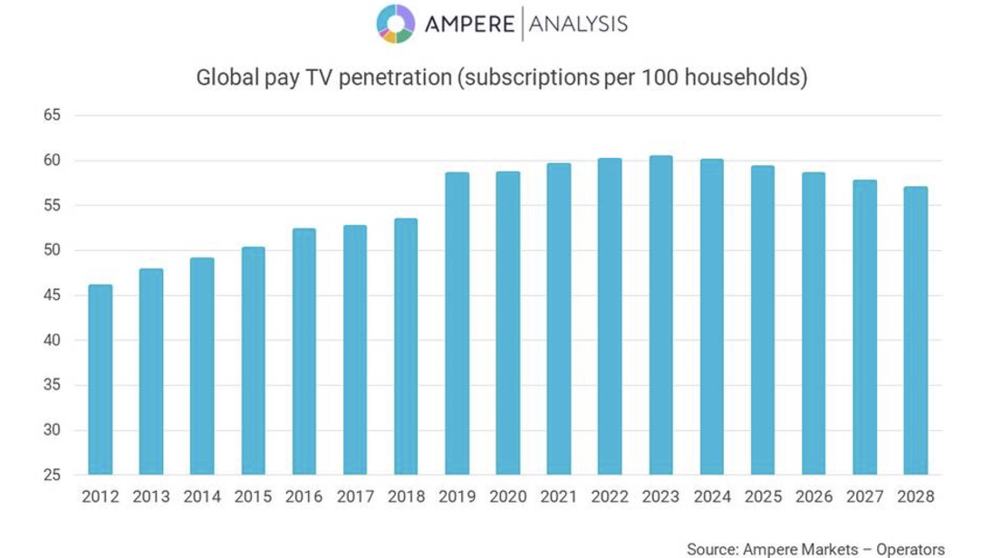
By 2028, global pay TV penetration will have fallen by almost four percentage points by Ampere’s forecasts.
In North America, pay TV penetration has almost halved from a high of 84% in 2009 to 45% in 2023 caused by a combination of high costs and competition from the SVOD market.
Despite this decline, the annual revenue generated per user will sit at over $1,100 in 2023 across North America, the highest across any region.
Latin America has also shown large declines in penetration since 2016. This is largely led by Brazil, which has posted a drop of roughly 10 percentage points since its peak pay TV penetration of 42% in 2016.
Although North America and Latin America are driving this shift, all regions will be in pay TV penetration decline by 2025.
By contrast, Asia Pacific and Europe have seen the highest penetration growth in recent years, with large gains coming from China Mobile after it acquired an IPTV license in 2018. This growth has mostly been driven by low-cost IPTV services, which are often bundled into broadband packages for a low or nominal cost. While these regions will also fall into decline after 2025, there are still some growth markets, such as Portugal, Serbia, Hungary which are expected to see further growth in the forecast period.
Rory Gooderick, Senior Analyst at Ampere Analysis, said: “Growth in global pay TV uptake has been driven over the last five years by Asia Pacific and Central & Eastern Europe. However, declines coming from the Americas, which are driven by streaming competition and the high price of pay TV in North America, currently sitting at over $90 a month, will contribute to global pay TV penetration declining for the first time in 2024.
“However, despite the projected decline in the reach of pay TV products, cable and satellite platforms will remain a powerful force in the TV world, and important distribution partners for streaming products, as evidenced by the recent distribution deal between Disney and Charter in the US, which saw select Disney streaming services bundled into Charter’s TV packages. This package structure, already increasingly common in Europe and parts of Asia, offers a framework for traditional cable TV companies to transition their business into a streaming aggregation play, and stabilise subscriber trajectories.”
You are not signed in
Only registered users can comment on this article.

RTS reveals Technology Awards 2026 winners
Evan Shapiro, ITN’s Jon Roberts, and On Air 2025 were among the winners of the RTS Technology Awards 2026.
.webp)
France Télévisions and TDF test 5G broadcast of Diagonale des Fous
For the mountain ultramarathon Diagonale des Fous, TDF has rolled out a 5G broadcast trial in partnership with France Télévisions, Antenne Réunion, and Web TV Grand Raid.
 (1).jpg)
CNN and Financial Times sign AI deal with Google
CNN has signed a strategic multi-year partnership with Google, which will see the organisation provide enhanced content rights for Google’s generative AI news product pilots.
 (1).jpeg)
150 students take over On Air 2026’s five-channel broadcast
On Air 2026 will see 150 students take charge of the Media Talent Manifesto (MTM) broadcast’s 24-hour culture, news, sport, film, and kids channels on 22–23 October 2026.
.jpg)
IBC calls for Challenge submissions for 2027 Accelerators
IBC has launched the official call for Challenge submissions for its 2027 Accelerator Media Innovation Programme.
.jpg)
.jpg)
